
SAP Interface Discovery: ABAP
Every interface in your SAP ABAP systems, discovered automatically
IDocs, RFC destinations, OData and SOAP services: SAP ECC, EWM and S/4HANA hold many interfaces that are rarely fully documented. The WHINT® Integration Cockpit reads them directly from your ABAP backends and combines them with the integration layer into one central inventory.
Backends are the blind spot
Middleware inventories show iFlows and APIs. But many interfaces start or end directly in the ABAP system, and some run without any middleware at all. These are exactly the ones missing when an S/4HANA transformation, an audit or an incident calls for a complete list.
Today
- Interfaces in ABAP systems are captured manually in spreadsheets through questionnaires and workshops
- Direct connections without middleware stay invisible
- Unclear which RFC destinations, services and communication users are still needed
- Backend and middleware are looked at separately
With the WHINT® Integration Cockpit
- Interfaces imported automatically from SAP ECC, EWM and S/4HANA and refreshed continuously
- Nine interface types, including IDoc, file, RFC, OData and SOAP
- Related communication users, Cloud Connector entries and BTP destinations included
- Backend interfaces linked with middleware into end-to-end integrations
Interface types discovered
The WHINT® Integration Cockpit reads interfaces via the APIs of your ABAP systems and assigns each one a distinct type.
IDoc
SAP_IDOCAsynchronous data exchange via IDocs.
File interface
SAP_FILEFile-based data exchange of the ABAP system.
ICF service
SAP_ICFHTTP services in the Internet Communication Framework.
RFC destination
SAP_RFCRemote function call connections to other systems.
OData V2/V4
SAP_ODATAOData services, e.g. for Fiori apps and APIs.
SOAP API
SAP_SOAPSOAP-based web services.
XI proxy
SAP_XIABAP proxies for communication via SAP PI/PO and SAP Integration Suite.
Communication arrangement
SAP_COMCommunication arrangements in SAP S/4HANA.
ASAPIO
ASAPIOIntegrations running via ASAPIO.
How it works
You can see the ABAP backends at the bottom of the graphic. The WHINT® Integration Cockpit links their interfaces with the integration layer above and passes the result to enterprise architecture and knowledge management.
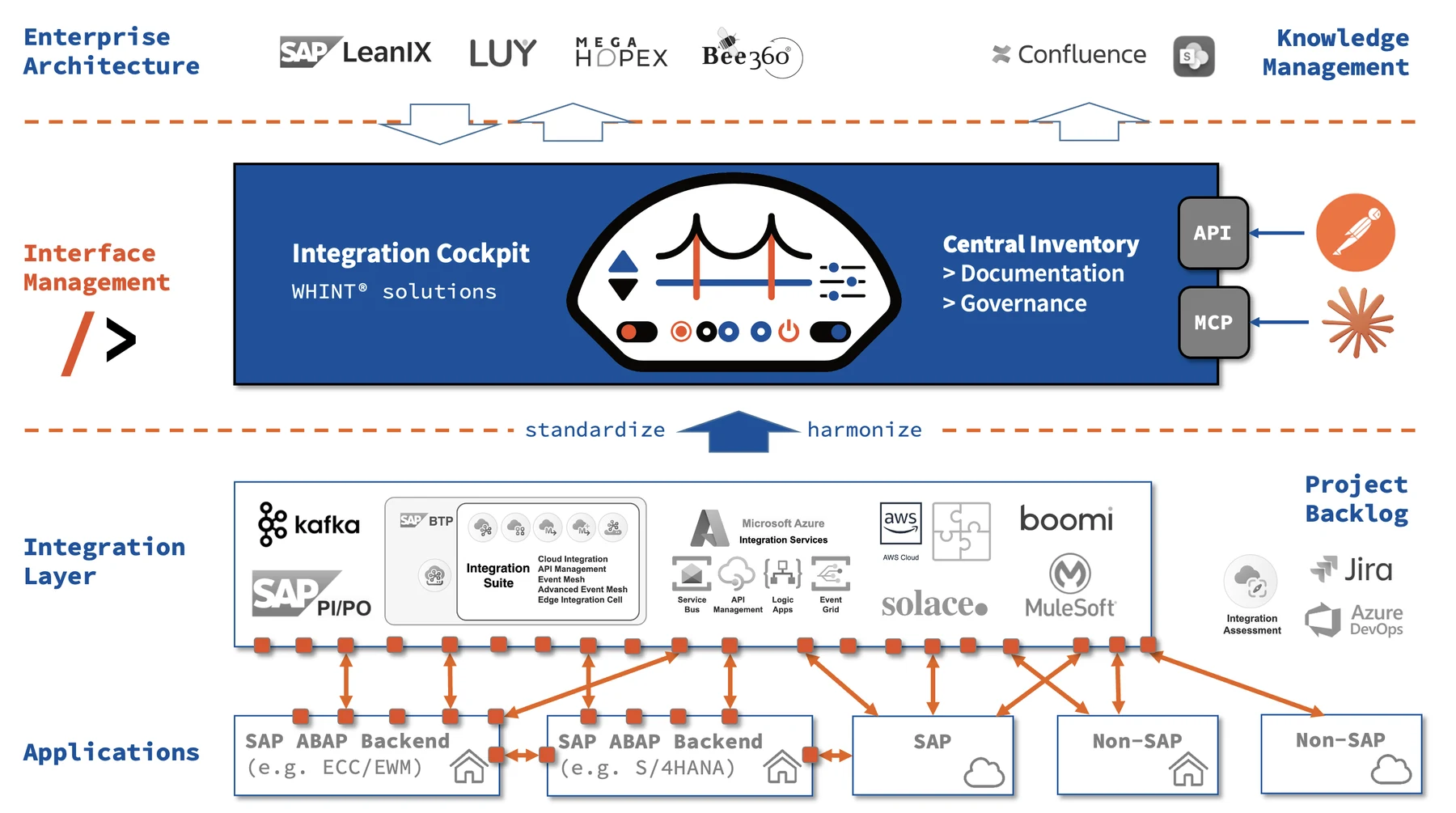
- DiscoverConnectors read interfaces and configuration from every ABAP system and environment, e.g. Dev, QA and Prod.
- HarmonizeRegex rules map technical sender, receiver and object names to canonical systems and objects.
- LinkBackend interfaces are linked with middleware into end-to-end integrations, e.g. API Management proxy → iFlow → IDoc.
- DistributeExport to your EAM tool (e.g. SAP LeanIX), to Confluence or SharePoint and as a CSV or Excel file, plus access via API and MCP.
What you gain
Sender/receiver & provider/consumer
Every interface includes message direction and API role, so you can tell push from pull data flows.
End-to-end view
From backend through middleware to the target system, visualized as a traceable chain.
Multiple environments
The inventory is kept per environment, e.g. Dev, QA and Prod.
Properties & tags
Add business domain, RACI or criticality and propagate them to related interfaces and end-to-end integrations.
To-dos
Configurable rules flag incomplete or non-compliant entries.
Decommissioning insights
Tracking the last traffic per interface produces a decommissioning list of candidates you can retire safely.
The basis for your S/4HANA transformation
Moving from SAP ECC to S/4HANA means knowing which interfaces exist today, which go away and which need to be rebuilt. The WHINT® Integration Cockpit delivers the as-is inventory from the ECC system and imports planned interfaces from Jira and SAP Integration Assessment. Properties and tags turn this into a project and timeline view.